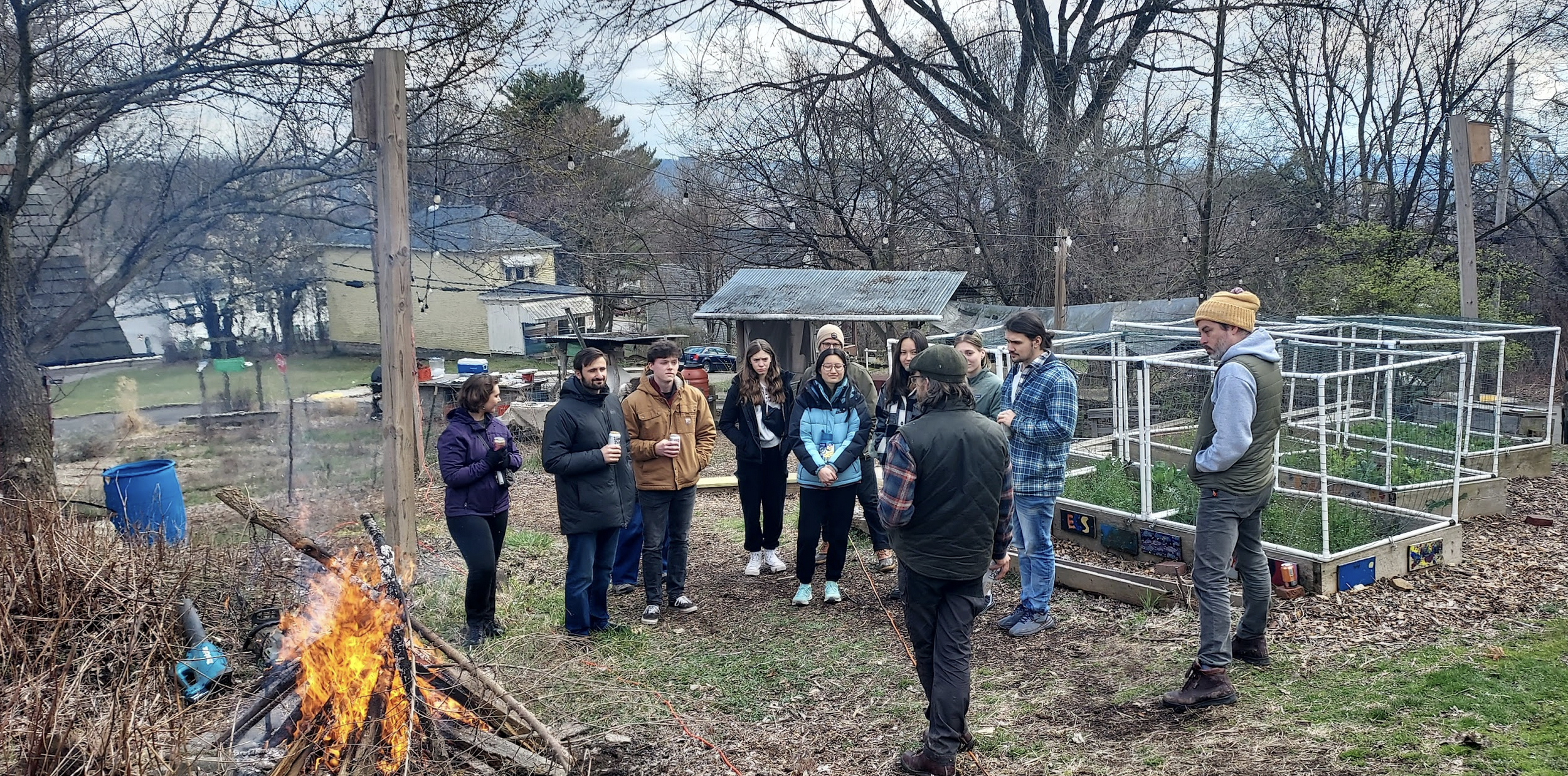
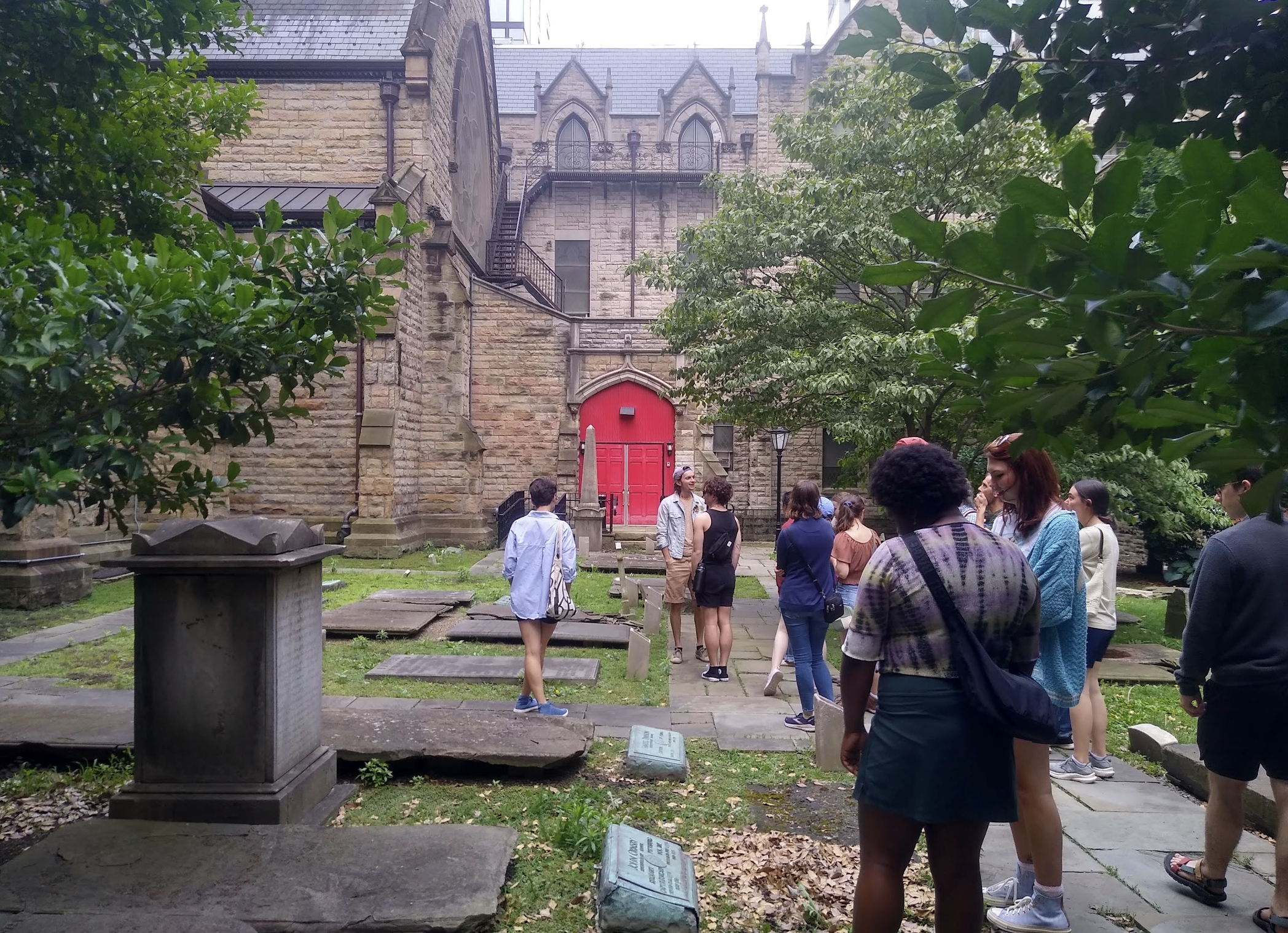
Students participating in the Miller Summer Youth Institute enjoy a site visit as part of their learning program at Pittsburgh Theological Seminary.
Getting real-world experience while in high school or college can be difficult. That lack of hands-on training can make it hard for those students when they begin to apply for jobs.
That’s why for the past 28 years Pittsburgh Theological Seminary has offered the Miller Summer Youth Institute, a program that allows late-aged high schoolers and college students to receive practical theological experience by participating in specialized leadership spaces.
“We ask prospective participants the question, ‘Are you ready for what’s next?,’ whether that’s going from high school to college or going through college into an occupation,” said Derek Woodard-Lehman, the director of the program. “We try to tell them and try to show them that this summer program is an experience in which they can find their place, find their passion and find their purpose.”
Started in 1997, the Miller Institute has included more than 500 participants ages 16-26 from 48 states and three countries. The cornerstones of the program are civic engagement, leadership development and vocational discernment.
“Civic engagement empowers students who want to make a difference in their community,” said Derek, who is in his seventh year at the seminary but the first as the Miller Institute director. “They maybe have some dreams or aspirations of changing the world when they grow up. We also do leadership development: how do you get others to come with you when you have a big idea or an important thing that you want to accomplish?
“The third thing is vocational discernment. For students who are in those emergent adult years trying to make decisions about who God has made them and how God is calling them, how do we help them find their way? We’re happy to have students who have some greater or lesser sense of a call to traditional ministry or Christian leadership – that’s a pretty straightforward pathway – but we’re also very interested in helping students who love God and love neighbor but love something else, whether that’s math, music or medicine. We believe that God cares about everything, and that all these things can be venues of service and witness.”
There are classroom times and small seminars to help the participants gain this important knowledge, but arguably the most meaningful experience of the Summer Institute are its off-campus learning experiences that allow for shadowing and first-hand engagement with church leaders.
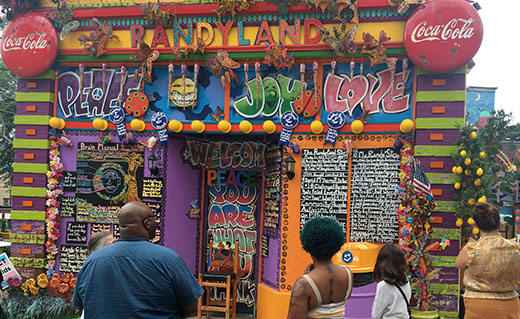
“We’re out and about, in and around Pittsburgh seeing congregations, organizations and persons who are doing innovative work that is building peace, working for justice and helping their communities flourish every day,” Derek explained. “Our hunch is that if young people can see examples of people doing creative and innovative work, they themselves might be able to imagine that kind of thing for their own lives.”
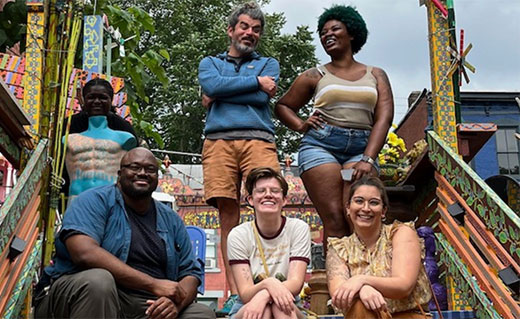 The participants, limited to a total of 16 who mostly reside in the Pittsburgh and tri-state areas, do not have to be affiliated with Pittsburgh Seminary. The program runs in June and July each year, with the college undergrads (four of whom are called “Miller Fellows”) this year gathering for six weeks from June 6 to July 19 while the high schoolers (12 of whom are named “Neighborhood Scholars” with a nod to the seminary’s most famous alum, Fred Rogers) converge on the seminary for four weeks beginning June 20.
Each of the weeks the students are on campus has a “thematic focus,” Derek explained. For example, during one of the middle weeks of the program, subjects like ecology, eco-theology and eco-spirituality are stressed. Through a partnership with the Wild Indigo Guild, students read Biblical passages about creation, nature and the relationship between humanity and land.
“We think theologically about the natural environment, particularly in the context of climate change and ecological crisis,” Derek said. “We spend lots of time off campus in the community at a handful of urban farms here in Pittsburgh with our sleeves rolled up and our hands in the soil actually doing urban agriculture as a practice-based experience.
“What we learn about natural ecosystems and the interdependence of animals, plants, humans, sunlight, water and so on become rich metaphors for understanding our social and spiritual interdependence. You can go very quickly from how does that tree grow to what’s your soil, where are your roots, who waters you, who provides you sunlight? Those natural metaphors of ecological interdependence become metaphors for spiritual and social interdependence to explore those things.”
Overlapping the two groups of participants is intentional and provides meaningful interaction between them while they are living on the seminary campus. In fact, each of the college undergrads has a small group of three high schoolers who they put under their wing and with whom they connect throughout their time together.
“While we are insistent that we are more of a ‘summer school’ than a ‘summer camp,’ the relationship between the undergraduates and the scholars is sort of akin to the relationship between councilors and campers at a summer camp,” Derek admitted. “The undergraduates are here for their own experience, but as we like to say, they learn while they lead, so they also serve as resident assistants in the dormitory and teaching assistants in the classroom.
“It’s a small intimate, immersive, supportive, living, learning community,” Derek described. “Everybody lives in the dorm here so it’s an immersive, intensive experience. It’s not like a day camp or a day school where you pop in and pop out and do your own thing the rest of the day.”
 Pittsburgh Seminary is one of just eight such institutions that still provides a summer learning program, a significant decrease from the 47 that at one time had it as part of their offerings. The program is fully funded, and every student earns a stipend while they are participating in the program to help offset any missed wages they are incurring because of their time at the seminary, with $6,000 going to each undergrad and $1,000 given to every high school student. The application deadline is April 30.
(For high school students, more information is available by clicking here and the application is available by clicking here. College students can get more information by clicking here and can find the application by clicking here.)
Those who are selected to participate in the Miller Institute will find that the commitment they’ve made will be well worth it.
“For the high school students, it’s a distinctive and special place where students can ask big questions about who God is, who they are and what the world is like and receive serious answers,” Derek said. “For both undergraduates and the high school scholars alike, I think it’s a distinctive educational program that integrates serious reflection with equally serious action. The third thing is it’s an immersive and supportive living learning community that helps them find their way in the world as they’re trying to decide what to do with their lives.”
Derek never participated in this type of program when he was in high school or college and admits that he wishes he had the opportunity to enroll in something of this nature as a youth. He’s glad he can now be part of this as an administrator.
“It excites me to be able to create a community and curate experiences that allow students in those formative years to have a brave space to take risks, ask questions and wrestle with serious issues and what they mean for someone as an individual and how they shape that emerging trajectory,” he said. “It’s really exciting to have the privilege of creating that kind of a living learning community, curating those kinds of experiences and then watching the exploration and transformation unfold for these next-generation learners.
“It’s really exciting and energizing to work with creative and innovative educators from around the city and across the country that we bring in to help facilitate these experiences for the students across the six weeks of the program.”
Creating real-world experiences is what the Miller Institute has been about for nearly three decades. In 2026, that will happen again for the 16 young people who are chosen to participate in this program with the hope that this exposure will lead them down a successful career path suited for them.
“One of the most consistent ways we can see God’s presence and work in the ways that students, whether it’s one at a time or sometimes the whole group, have one of those ‘ah-hah moments’ where something clicks for them,” Derek said. “They see a connection between what they read in the Bible, what they experience in church, in youth group, in their campus fellowship, and something that’s going on in the real world. Those scattered dots aren’t just dots anymore, but they’re a constellation, a picture that makes sense, that helps them understand who God is, what the world is and who they are.”
For more information on the Miller Summer Youth Institute, contact Derek by email at dwoodardlehman@pts.edu.