
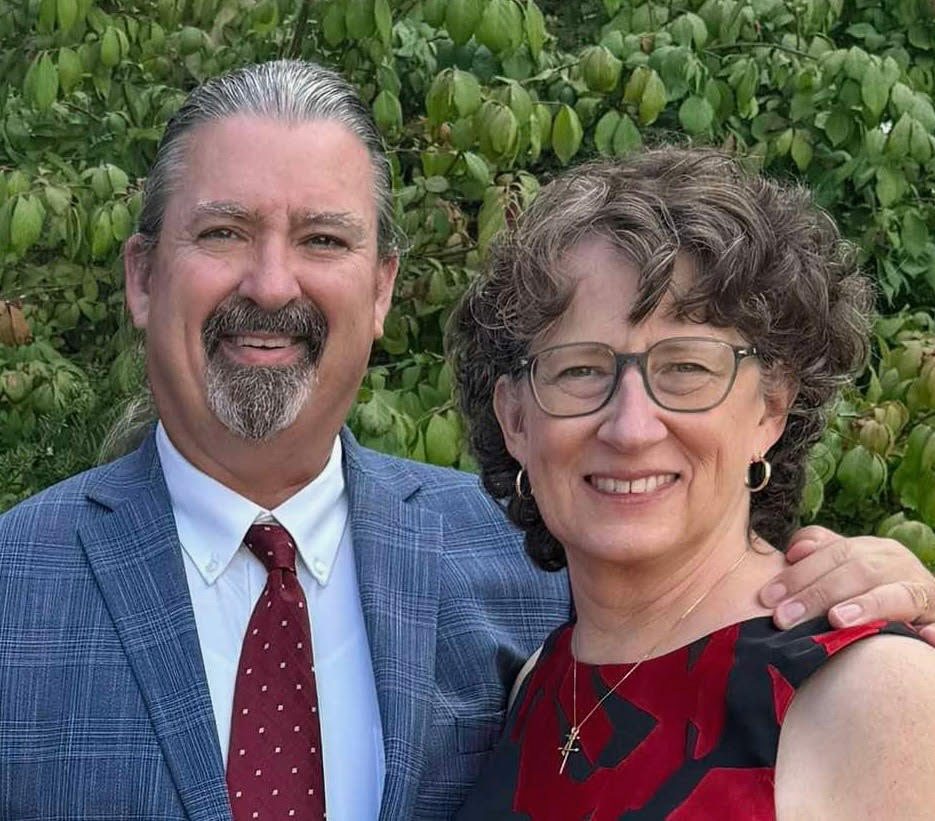
Rev. Dr. Bill Myers, pictured with his wife, Margie, will stand for moderator of the 227th General Assembly of the Presbyterian Church (U.S.A.) in Milwaukee in July.
Rev. Dr. Bill Myers has called many places in the United States home. Born in Hawaii, he has served as pastor of congregations in Michigan, Illinois, Iowa, Pennsylvania and New Jersey before landing in his current home at the First Presbyterian Church of Charleston, WV. The cultures and ways of life he’s experienced have given Bill a perspective like no other.
“It’s been a tremendous example of trusting that God will put us where God chooses and give us the resources to do the ministry God calls us to do,” Bill explained. “I ended up in all the places that I did, and in all those places – their stories, their faith and the unmistakable ways that God continues to show up – in the words of the Grateful Dead, ‘it’s been a long, strange trip,’ but it’s been a great one.”
The next destination Bill feels the Spirit calling him is Milwaukee. That’s the location of this summer’s 227th General Assembly of the Presbyterian Church (U.S.A.) where he will stand for moderator of the denomination. It’s something he started seriously thinking about before the 2024 General Assembly in Salt Lake City, UT, but a call he has considered for a while.
“From the beginning of my ministry, it’s always been in the back of my mind,” Bill said when asked about standing for moderator this year. “I’ve come to First Charleston, and interestingly enough a child of this church, E.T. Thompson, was moderator. He was in the southern church, and he helped bring the northern and southern churches together in the ’80s.
“I’m very much aware of people and history throughout our denomination in part because I’ve had the privilege of meeting so many extraordinary people. It’s always been in my mind that that opportunity (of standing for moderator of the denomination) might come someday.”
As of late April, Bill had not yet selected a person to stand with him. At the last five General Assemblies dating back to 2016, co-moderators were elected following a long history of moderator/vice moderator teams. Bill is leaving his options open regarding selecting a “co” or “vice” moderator to accompany him to Milwaukee later this year.
“I’m looking for a co-moderator,” he admitted. “If it turns out that they would prefer to be vice moderator because of time commitments, I’m open. It really comes down to the time commitment. The two people would sort out which responsibilities they’re going to handle together and which they are going to handle separately.
“In my mind, I’m not sure it makes a whole lot of difference in terms of the whole nature of the team. It really comes down to the two folks standing to determine what their comfort level is.”
UPDATE: Rev. Dr. Barbara Barkley has agreed to stand with Bill as co-moderator. Click here to learn more about Barbara.
Bill having lived in and quickly adapted to different parts of the country makes his ability to find the right running mate easier than for some. He knows the backgrounds of the regions, and that history is something he feels is important to the PCUSA.
“I was born in Hawaii,” he said. “I feel like there are stories in West Virginia and places like Hawaii that need to be told and need to be shared. Part of that comes from recognizing that the national narrative when it comes to West Virginia is brutal. Here, West Virginia historically has provided so much in terms of the life of the mind, the Apollo space mission, athletes, child labor laws. Huge things, not to mention the coal that has pretty much run the world.
“Yet all of these good things are taken out of West Virginia and West Virginia hardly gets any credit for having shaped the world. It comes down to this opportunity to tell these stories that are vital for our future and yet are not always heard.
“My sense of call for running for moderator is that West Virginia has stories to be told. They’re not my stories. I have an opportunity to create space for others from West Virginia to tell their stories. I’m looking at presbyteries and synods for a good match of standing for moderator with the theme around these untold stories.”
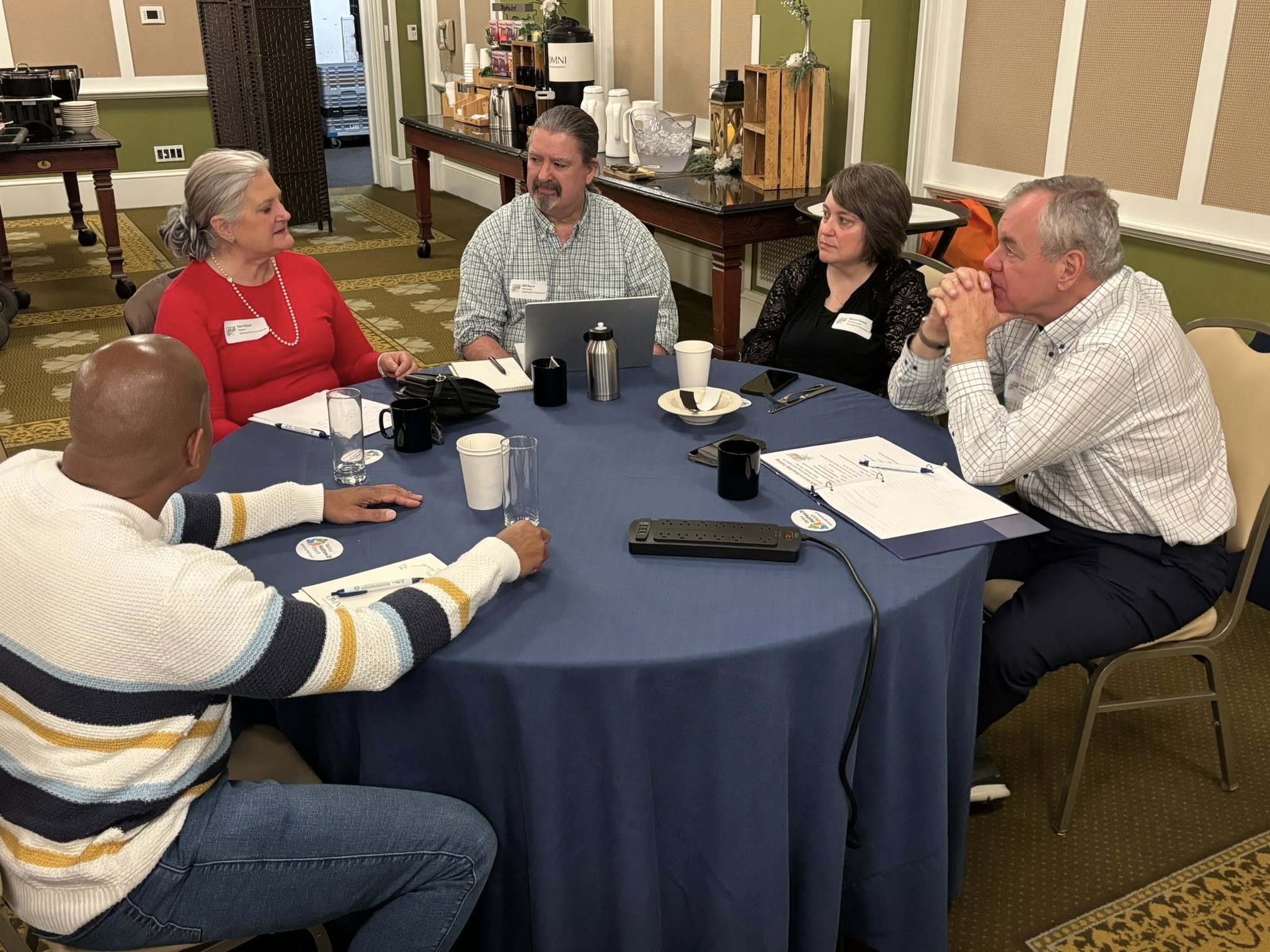
Bill Myers, center, participates in the Synod of the Trinity’s General Assembly training in Bedford, PA, in April.
Being able to reflect on the past and learning how things have been shaped are key, Bill says, to the direction the PCUSA will go.
“The future of our denomination, at least part of it, is tied to learning how some of our smaller congregations have learned to thrive in spite of limited resources and limited people,” he said. “For some of our congregations, they’ve been able to do some amazing things in ministry: walking with people, feeding people, caring for children, being with people who are in recovery. Things that churches are supposed to do, they’ve been able to keep doing those things in light of all of the cultural challenges we’re facing.
“I think the stories of resilience are very important – stories of joy and celebration, to know that these churches are making a difference.”
Bill vividly remembers walking into a Presbyterian church near West Virginia University where his son was leading worship and seeing roughly 50 back-to-school backpacks filled with school supplies lining the walls of the fellowship hall. What he saw in the sanctuary provided a different narrative of this congregation.
“It’s a very attractive small church,” Bill said. “The parking lot was brand-new, the fellowship hall was welcoming and warm. The sanctuary was lovely. We went up for worship and there were 10 people. That church certainly has the resources to keep its facilities in good condition, certainly has the resources to make a difference in their community, and yet in terms of worship attendance, a lot of presbyteries would have written them off.
“Back in the ‘glory days,’ a lot of us would have written them off because it was about members and money. That was the mark of a vital, healthy church. The more members you had, the more money you had, the more vital you were.
“I think those days are gone and yet we have any number of churches like this one that they’re showing up every day. They’re doing what they’re being called to do with the resources God has given them. We don’t know if they have five years or 50 years, but what we know is today they’re being faithful.”
Racial justice, social issues, the war in Iran and many other current topics will be discussed at this year’s General Assembly. Bill knows these subjects with be front and center in Milwaukee.
“All of those issues are vital,” he said. “They’re all things our denomination has to deal with at some level. One of the things that I bring to the table is certainly an awareness and appreciation for things like racial justice but also the fact that we have an opportunity to show the world how to move forward, how to live together, how to remain at the table with people that not only do we not agree with but in some cases we despise.”
In the five years Bill has been at the First Church of Charleston, the congregation has continued to have a strong presence in the community. It’s Hope Village ministry generates $80,000 a year for the church’s world partners, and the church also awards $125,000 a year in mission grants.
“We have an abundance of opportunity and resource, but what I tell our folks, as important as a lot of that stuff is, the most important thing we have to offer our community is to show them how people who don’t see the world the same way can get along and do things for good,” he said. “One of things I bring to the table is the capacity to keep people at the table until we can get something done.
“There’s so much loneliness in our world, there’s so much hatred and division. How can we ever hope to solve some of the cultural issues or some of these other challenges if we can’t even get along?”
Having cohesion in the world is ultimately what Bill hopes to bring to the PCUSA if he’s voted into the role of moderator for the next two years.
“It’s about telling stories – that’s kind of the focus if you will – but it’s more than that,” Bill said, explaining his platform. “It’s the purpose of telling these stories and that is of building relationships, of giving people hope that if we’re resilient, if we’re welcoming, we can find ways to overcome the things that divide us. And then maybe by doing that we’ll have more of an ability to address some of these challenging cultural issues together.”