
by Kristin Rhodes
Communications Coordinator
Presbytery of West Virginia
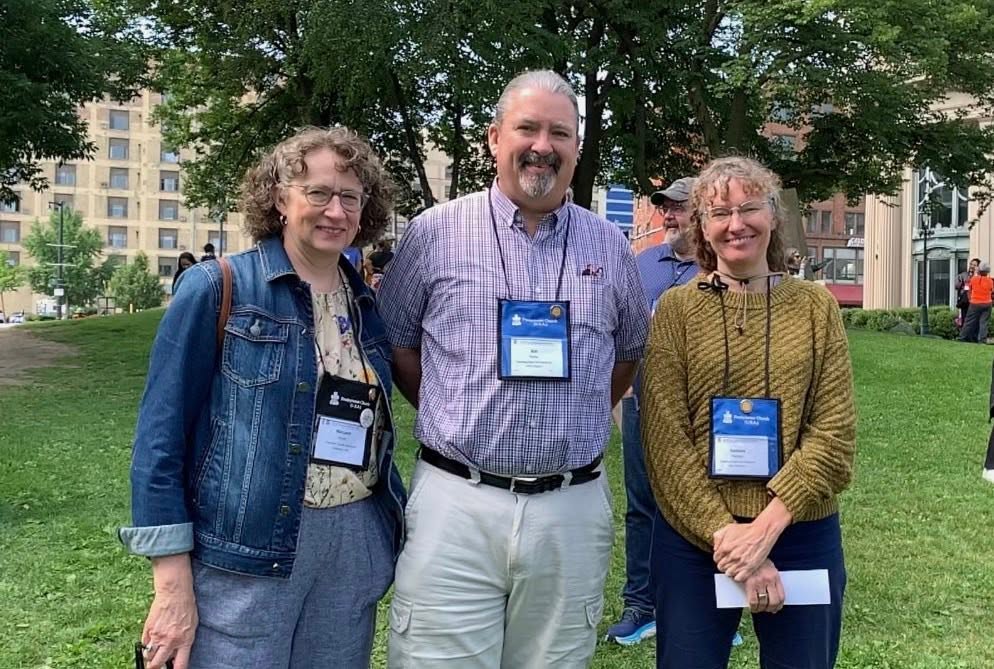
The Rev. Dr. Bill Myers of the First Presbyterian Church of Charleston, WV (middle) stood for co-moderator of the 227th General Assembly along with the Rev. Dr. Barbara Barkley (right). They are pictured with Myers’ wife, Margie Myers in Milwaukee.
While General Assembly is always an exciting experience for those who attend, it was extremely memorable for the Rev. Dr. Bill Myers of the First Presbyterian Church of Charleston, WV. In April, Myers announced his stand for co-moderator of the 227th General Assembly in Milwaukee, WI, alongside the Rev. Dr. Barbara Barkley, pastor of Clayton Valley Presbyterian Church in the San Franscisco Bay Area. Although the outcome was not as Myers and Barkley hoped, he greatly enjoyed the conversations he had with attendees and seeing the Spirit throughout the week.
Standing on the conviction that God is at work in overlooked places, Myers focused on telling the stories of small congregations full of hope and resiliency. During GA, the response to those stories was greater than Myers expected. He found when people approached him, these stories were the topic of discussion. The Celebrating Small Congregations posts Myers and Barkley shared confirmed their hunch that people in the church yearn to tell their stories and are hungry for reconciliation.
“Those stories reminded people God is still doing remarkable ministry in places that are easy to overlook,” Myers said. “People wanted to talk about reconciliation — not as another program, but as a different way of being the church. I met a number of leaders from across the denomination who weren’t interested in replaying old arguments. They wanted to know how we move the church forward together. That gave me hope.”
Myers recalled several worship leaders circling back to the theme of reconciliation; themes of reconciling people, not ideas, stayed with him. Believing one of the biggest challenges within the church is relational, the conversations of healthier churches with pastors, ruling elders, seminary students and young leaders who displayed a love for the church also gave him hope as they reminded Myers that God is “already raising up thoughtful, faithful leaders whose first instinct is not to win, but to serve.”
Myers acknowledges that healthy churches stem from healthy relationships, so the restructuring of committees and rewriting of manuals still carry wounds until the trust they are built on is repaired.
“Organizational change alone will not bring the unity we seek. Structures matter, but they cannot heal divisions, rebuild trust or create the relationships that hold us together. People want to know they are seen. They want to know their ministries and voices matter,” stated Myers. “Our future will be shaped not only by what we create in committee rooms, but by whether we learn to listen, trust and walk with one another again. We cannot legislate reconciliation. We have to practice it.”
Even in discussing fractured spirits with individuals during GA, Myers saw the Spirit, perhaps most clearly during the work of the Racial Justice Committee, where honest conversations were held regarding how processes affected committee members. The next morning, the committee changed the way they worked because of to the careful listening the day prior. He also saw the Spirit during the Assembly where thoughtful and faithful decisions were made, which reminded him God is always at work through us.
“That’s the church at its best — not because we got everything right the first time, but because we were humble enough to learn and do better,” he explained. “The Spirit is still leading this church, even as the Spirit continues to reform it.”
Encouraging anyone considering attending GA in the future, Myers says to come with open eyes, as the work inspires, frustrates and stretches attendees. Seeing deep divisions still remain, he believes the remarkable people doing faithful work are still using discernment, but that factions must be moved past if the PC (USA) is going to become the church we aspire to be.
“I left believing our greatest needs are authenticity, transparency, honest communication and relationships strong enough to hold disagreement. Those don’t happen by accident. They happen when people keep showing up. They happen when we’re willing to tell the truth — not simply about our successes, but about the work that still lies before us.”
For Bill Myers, the work that lies before the church did not end at the conclusion of GA. It is a hard effort that he will diligently peruse; providing a voice to the small congregations doing great work and glorifying God for the many ways the Spirit is still at work.