
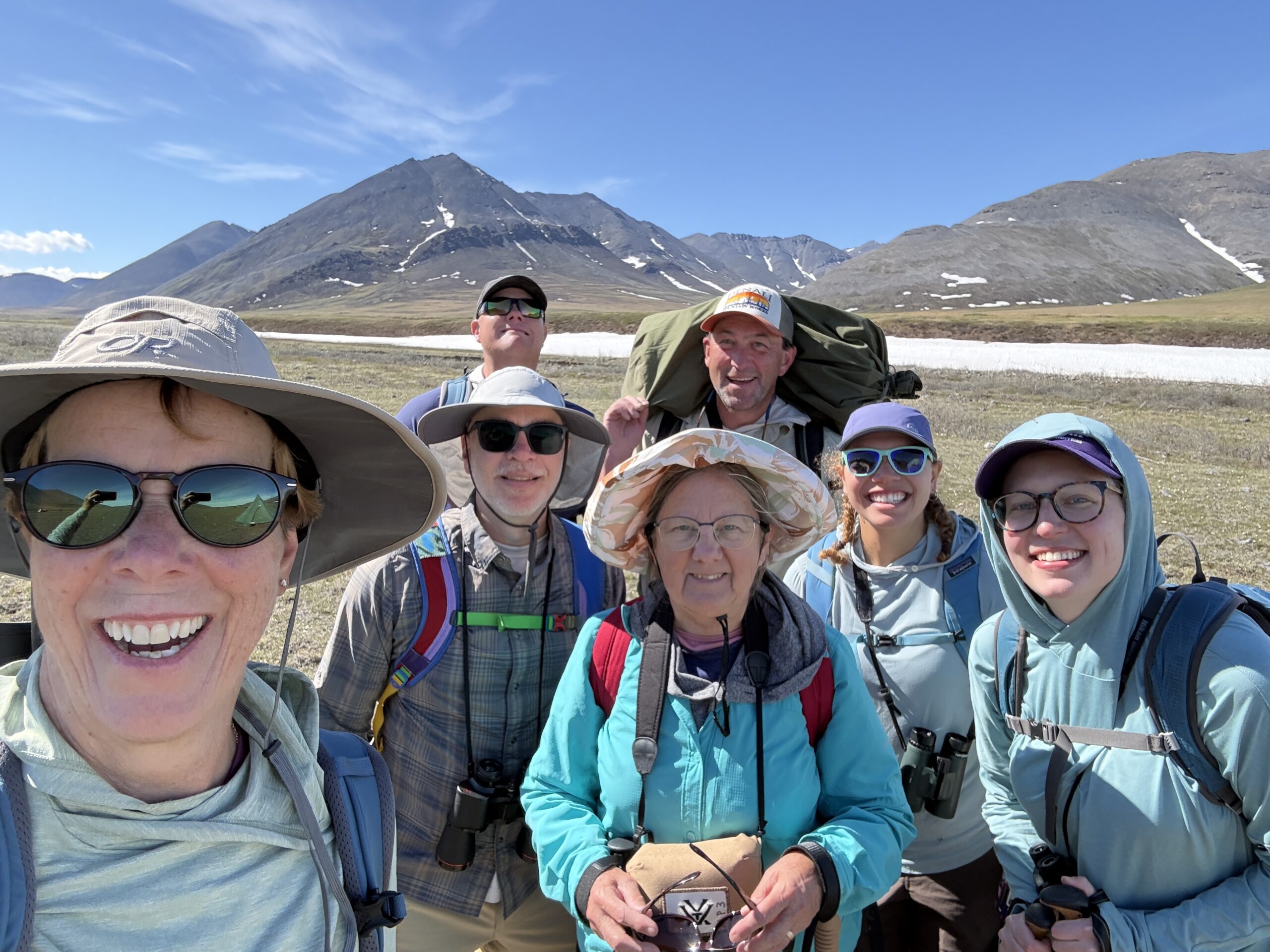
Courtenay Willcox, the moderator of Presbyterians for Earth Care and transitional pastor at Northamption Presbyterian Church in Holland, PA, takes a selfie with her group in the Arctic in June.
Courtenay Willcox was never involved personally in an environmental crisis. She hasn’t encountered something catastrophic that ripped apart her property and left her and her family sheltered with no place to go.
Those experiences are oftentimes on the resume of someone who leads earth-friendly outreaches and missions. But for Courtenay, a minister member of the Presbytery of Philadelphia who doubles as the second-term moderator of Presbyterians for Earth Care, it’s simply a calling that has her focused on preserving the world we live in.
“I do believe it’s one of our calls as Christians,” Courtenay said. “It’s a Christian response. It’s always been on my heart. I’m not sure why. Nothing ever happened (to me), so God put it there, and I’m responding to that call.
“I think we have many calls in our lives. I don’t think there’s just one. I’ve been called to many things. This is one of the big things. This is one of the three legs of my stool.”
The founder of what is now called Main Line PA Interfaith Power and Light, which urges bold and just action for climate change, and a former board member of Heeding God’s Call to End Gun Violence, Courtenay is well-versed in environmental and social issues affecting her and her neighbors.
“I think Presbyterians for Earth Care is an important community in which Presbyterians can gather and they learn,” she said. “They have a community of people who care about creation the way they care about it, and they can brainstorm on ways to make a difference. That has always been my goal – to kick the ball down the environmental field. I think creation care is one of the most critical things our world faces.
“I think environmental racism is something that is really at the crux of what we do as a Presbyterians for Earth Care organization, recognizing the fact that it’s people on the margins, it’s people with black and brown skin who are the most likely to be impacted by environmental issues like pollution and development.
“Often, we only think about ourselves. We don’t think about the bigger picture and that whole idea of us just being a strand in the web of life. Humankind is not the web of life. God created way more than that.”
Courtenay experienced the vastness of the Earth firsthand in June when she visited the Arctic for five days as part of a small group of other faith leaders that also included another Presbyterian pastor from New Mexico. Courtenay, the current transitional pastor at Northampton Presbyterian Church in Holland, PA, was in awe of what she experienced.
“There are so few people in the country that have ever been in the Arctic National Wildlife Refuge, that have ever been above the Arctic Circle,” she said. “The seven of us were plunked down in the middle of nowhere like nowhere I have ever been.”
The trip came on the heels of another attempted sale of property to oil and gas companies that targets areas on the coastal plain of the Arctic National Wildlife Refuge. While previous lease sales have received minimal interest from major oil companies due to significant costs and public backlash, there is still a continued focus on the lands for new drilling and development. By sending groups of faith leaders and members of the media to the area, their experiences create energy to help preserve the Arctic lands.
“I went up thinking this is going to be a trip for 2026 that I can talk about,” Courtenay said. “But it was a trip of a lifetime that will keep informing me for the rest of my life. It shows up for me in conversations with family, with friends, with strangers, in my sermons and in my dreams. It is just something that has seeded itself like nothing else.”
Courtenay and her group needed three planes to get to the Arctic, the last of which was a bush plane that was so small it had to make two trips to get all seven people to their campsite.
“A two-burner white gas stove cooked all our meals,” Courtenay said. “We hiked on the tundra. There are no trails. There’s nothing there, including no trash. There’s no litter. It’s just pristine. Our campsite was beside a stream that was fed by the melting snow off the mountain. When we left, (the guide) said we’re gonna let this land rest now.”
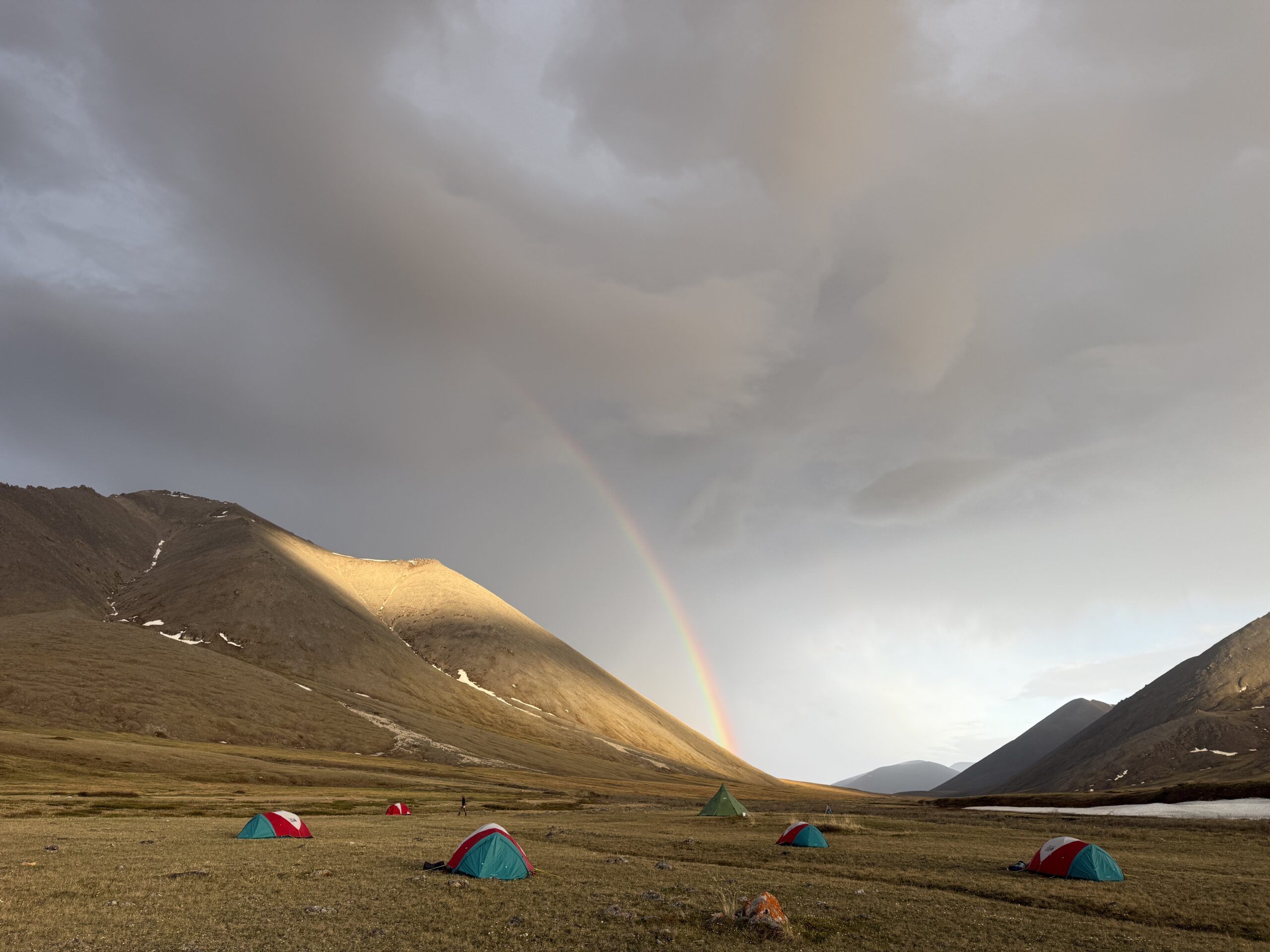
A rainbow is cast over the campsite of seven faith leaders who traveled to the Arctic in June.
With the trip occurring in early summer, the temperatures reached as high as the upper 70s. June also meant there was daylight all day long.
“The sun never set,” Courtenay explained. “The sun went around our campsite, which was just amazing.”
Sitting around their tents on their final night, the group was spotted by a herd of caribou. It was a surreal moment for everyone there.
“Behind our tent there were four caribou, looking at us looking at them,” Courtenay recalled. “I felt like it was a little bit of a holy moment, them sort of bidding us goodbye. They were not scared of us because they don’t see humans. They were as curious about us as we were about them. They walked away looking over their shoulder at us.”
Purple saxifrage was also prevalent. The purple flower was grounded in soil just 12 inches above the permafrost, frozen soil that is closer to thawing and releasing trapped gases like carbon every day due to climate change.
Upon her return, Courtenay is sharing her experiences regularly behind the pulpit at Northampton Church.
“I’m using a story from the Arctic with every sermon in the season of creation just to talk about my time there,” she said.
Courtenay does feel there is some traction occurring in the fight for awareness of earth care issues. At this year’s General Assembly of the Presbyterian Church (U.S.A.), two overtures were passed in the consent agenda that dealt with things like the divestment from fossil fuels and regenerative agriculture. A third that awards money to people who have been affected by environmental degradation created by fossil fuel and chemical companies was also passed through the consent agenda.
While it’s a start to have the denomination backing Earth-conscious reforms, Courtenay knows it will take everyone to change the current path of the environment.
“Presbyterians are not going to fix this Earth care conundrum,” she said. “Christians are not going to fix this Earth care conundrum. We need to gather with all people of faith. I do believe that we’re stronger in our interfaith efforts.”
Presbyterians for Earth Care has many resources available, including things like Advent and Lenten devotionals and monthly webinars. It’s a start for those wanting to become more involved in this movement. It’s become a passion for Courtenay, who hopes more will follow in her footsteps.
“I look around and I see God’s genius in creation everywhere, and I live in the suburbs,” Courtenay said. “So, you can imagine how it was being in this remote area hundreds of miles away from any other humans and looking around at what God has done and how these animals that live in the tundra are able to acclimate to this really harsh, harsh, harsh environment.
“We are called to do what gives us life. This is something I deeply, deeply care about.”
For more information on Presbyterians for Earth Care, contact Courtenay at pecmoderator@gmail.com.