
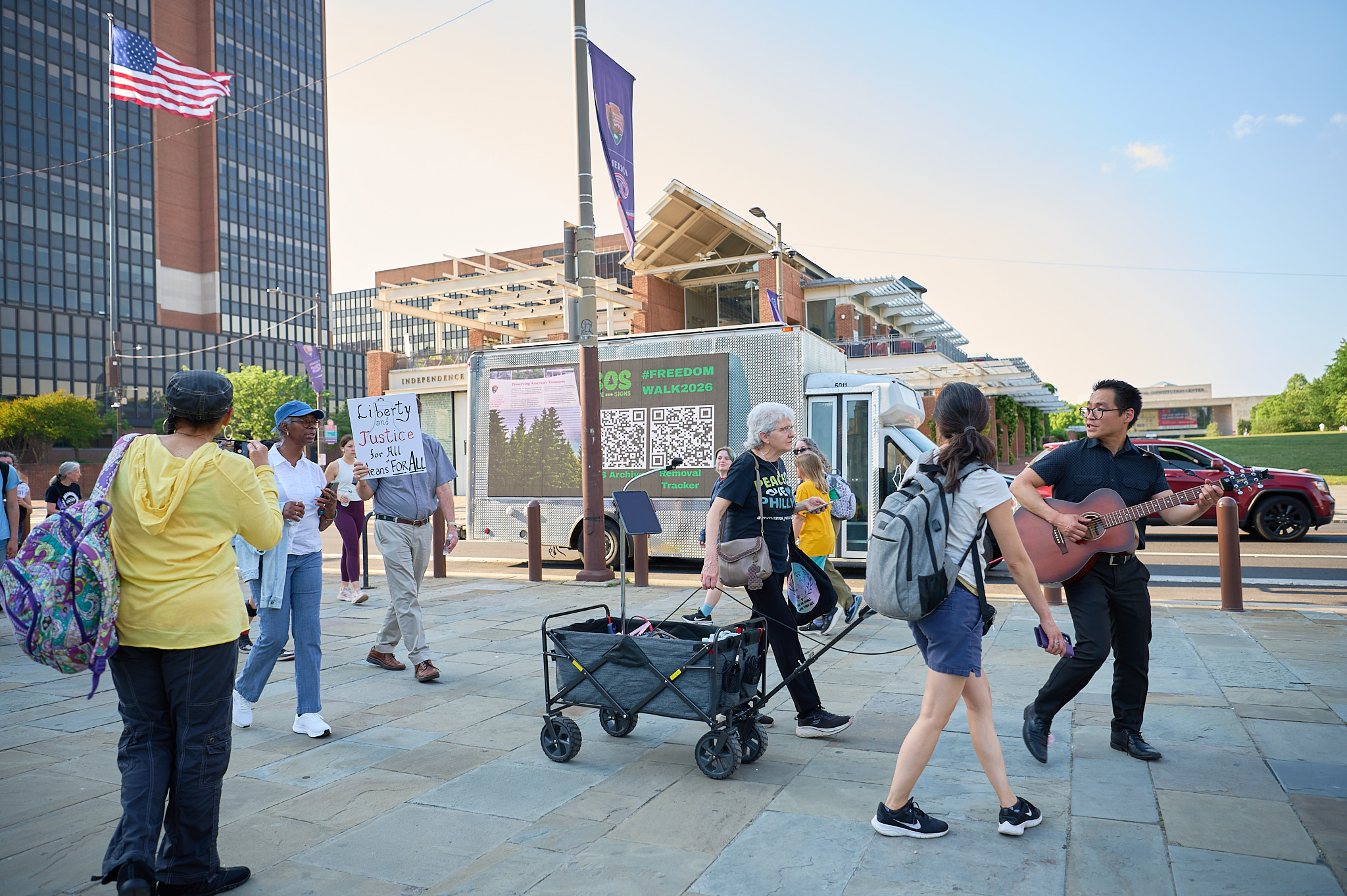
Pastor Peter Ahn leads a group during the Freedom Walk – a modern-day retracing of the Underground Railroad to Canada – that occurred prior to celebrations for the the 250th anniversary of America’s independence. (Photo by Daniel Chen)
The Fourth of July is a holiday where millions of Americans gather around barbecues and under fireworks displays to celebrate the day when the United States gained its independence from Great Britain. For millions of others, however, it is a time of sadness, grief and reflection as the day stands for the beginning of enslavement and the displacement of Indigenous people.
Peter Ahn, the pastor at Olivet Covenant Presbyterian Church in Philadelphia, understands that emotions differ on this holiday from person to person.
“Not everybody celebrates the Fourth of July,” he said. “Black communities and Indigenous communities. Folks like Mark Charles would say we should designate the Fourth of July as a day of national mourning.”
Because of this, Peter has taken it upon himself the last few years to be a leader in his community for events that bring awareness to those who have been mistreated. From concerts to art collaborations to events linking Juneteenth to Independence Day, Peter is at the forefront for these gatherings.
“As a Korean American, I recognize that oppressed people can also be oppressors at the same time,” he said. “I’m also doing my own work of Black communities and Korean American communities. There are misgivings among these people groups, too.
“In our policies, I see how the billionaires are collaborating while communities of color are divided. There is a consolidation of power and resources towards the top while other groups are divided and fighting for that tiny little piece of pie. That’s why I do the work, so that we don’t sabotage each other’s work.”
One of the first events Peter organized a couple years ago was at the Eastern State Penitentiary in Philadelphia, which is now a museum that educates visitors about mass incarceration and restorative justice. Gatherings were held there annually for a couple of years on Martin Luther King Jr. Day and Juneteenth.
Peter collaborates with Waverly Alston Jr., the music director and composer of Black Breath Collective, which is a group of local singers and musicians who perform in a story narrative art form as a way of educating listeners about justice issues. Furthermore, the Olivet Covenant Church has a second-floor studio where local artists can gather and create their works.
By helping to organize spaces where people can express their feelings toward previous wrongdoings in this country, it can open conversations that help with a healing process that is long overdue.
“Some people are very anti Fourth of July,” Peter said. “It is a freedom for some people, but it’s not for everybody. Therefore, we start with the Fourth of July as a partial freedom, and we create a narrative of a trajectory of more freedom for more people by highlighting Juneteenth.
“Today, when we look at the trajectory, then we can ask the question, ‘How are we not all free?’ As Fannie Lou Hamer says, ‘Nobody’s free until everybody’s free.’”
For the last three years, Peter has been examining the history of the Fourth of July, which has included many protests by those who feel Independence Day has a negative side.
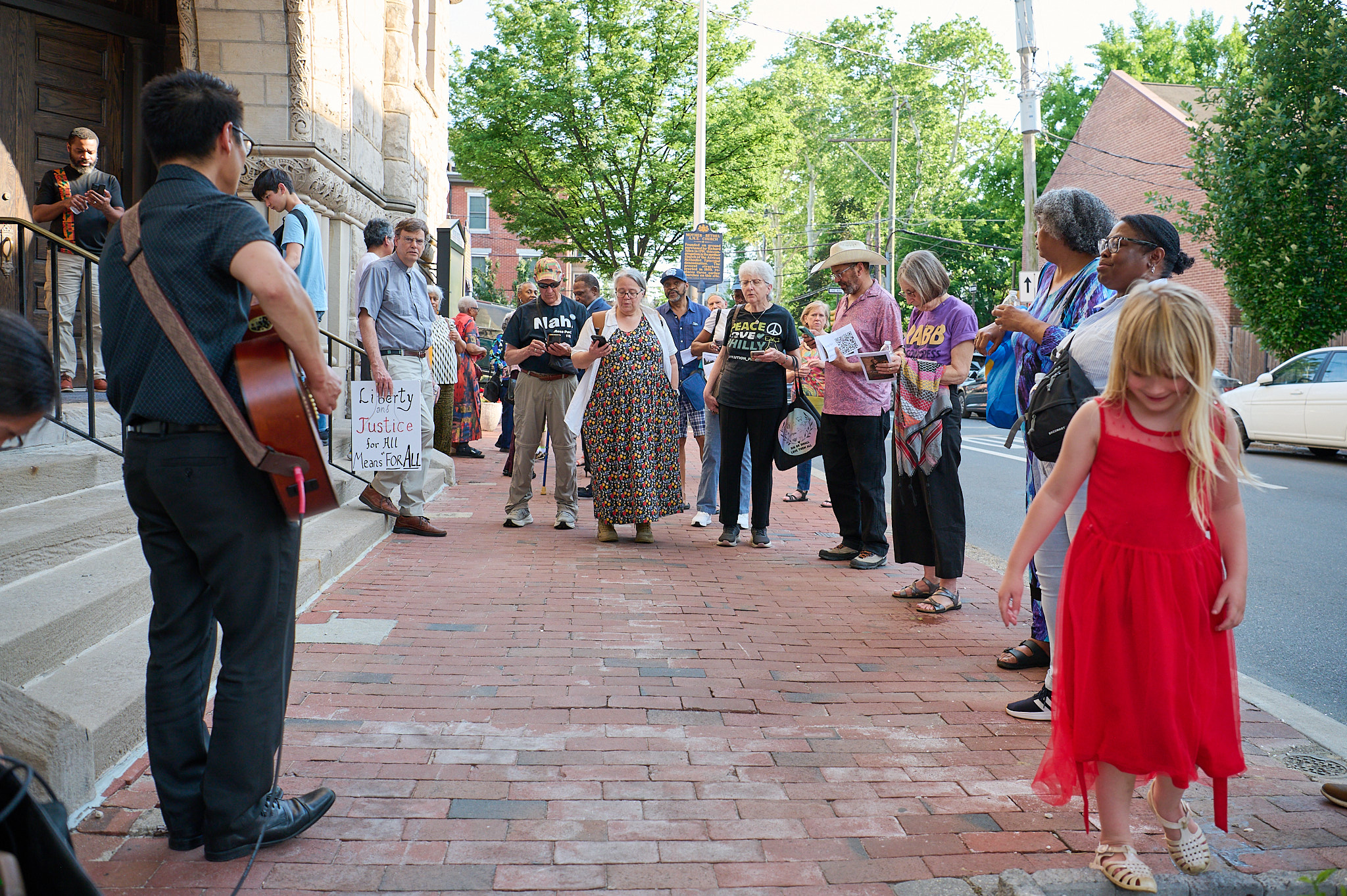
Peter Ahn plays his guitar during a stop on the 2026 Freedom Walk in Philadelphia. (Photo by Daniel Chen)
“All of the people who are not included in the initial Fourth of July – women, African Americans, Indigenous people, people of color, LGBTQ+ communities, various people who are not included in that freedom – we are going to highlight that by celebrating both Juneteenth and Fourth of July as our overall narrative,” he said. “That’s how I’ve been trying to bridge the gap so that we don’t create our identity based on an anti-you movement.”
In 2026, Peter and others have partnered with Coming to the Table, a national network of people who follow a non-violent framework of doing “circle process” (which relies on equal participation, deep listening and a “talking piece” to ensure everyone is heard) and restorative justice.
Several “Pre-Juneteenth” events, as Peter called them, where held in May, highlighted by a concert at historic Mother Bethel African Methodist Episcopal Church in Philadelphia that included a march from the church to a slavery memorial at the former home of the first U.S. president, George Washington.
“We didn’t want to just walk right into Juneteenth or Fourth of July,” Peter explained. “Our work has been more of cultivating a culture of telling the truth, cultivating a culture of rediscovering our past. Telling the good, the bad, and the ugly because if we want to really love ourselves as a community then we need to accept it all and create room for grace.
“Then we encouraged people to find opportunities in their local areas to participate in Juneteenth. Miss Opal Lee, who was really the major push to make this a national holiday, her vision was to bring people from places of oppression and privilege to together celebrate this and really treat it like a national holiday, but this continues to be a very segregated celebration.”
Peter feels like the efforts have not gone unnoticed.
“I think there’s a little bit more of an intention from some folks in this area to recognize Juneteenth more intentionally, so that’s good,” he said.
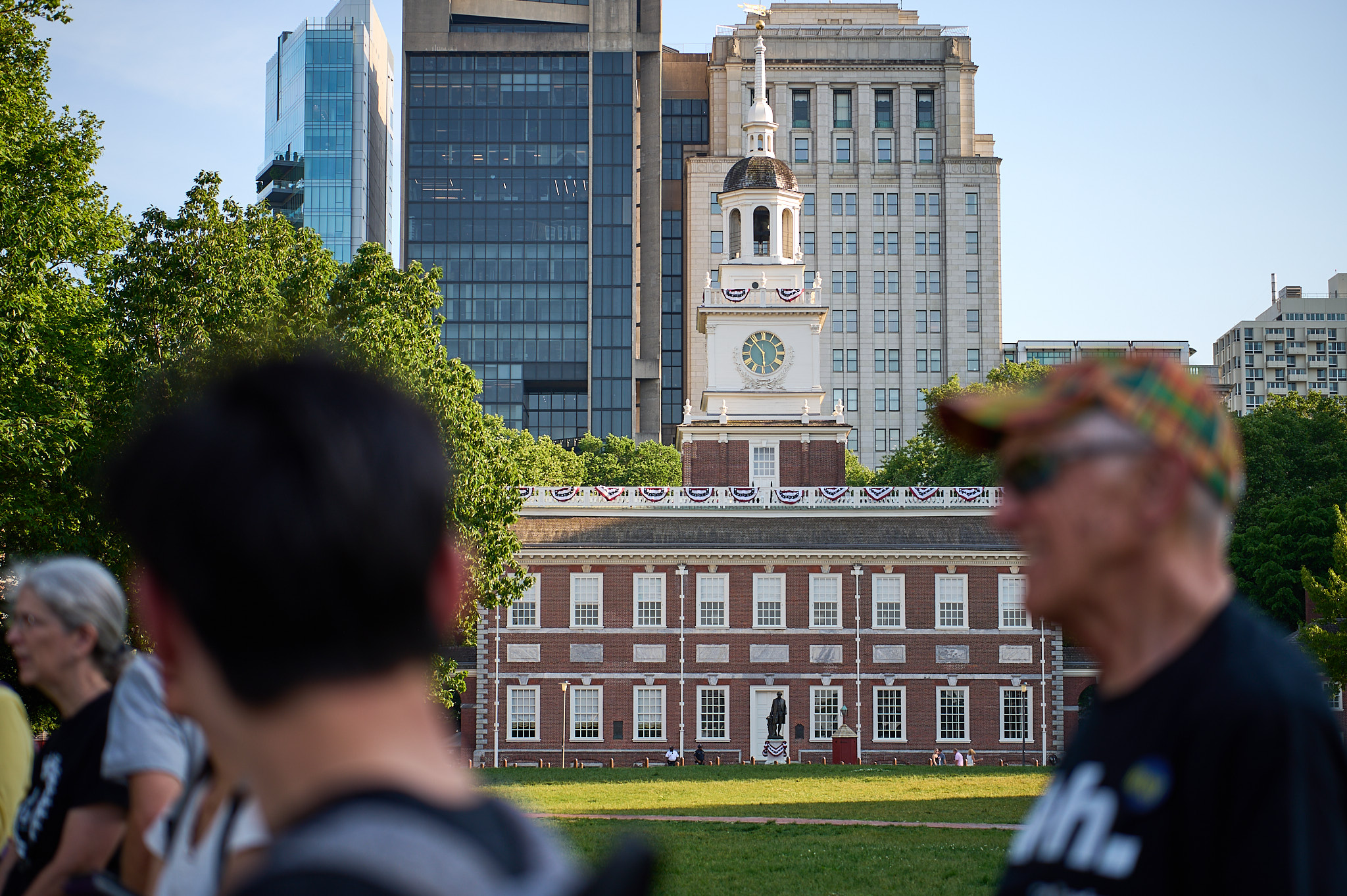
Walkers pass Independence Hall in Philadelphia during the 2026 Freedom Walk. (Photo by Daniel Chen)
Peter certainly has not done the organizing and planning alone, and members of his congregation at Olivet Covenant Church have walked with him as he creates these gatherings. However, he doesn’t force participation on anyone.
“I don’t push anything with people,” he said. “I just lead by example. I don’t create it as a church program. People just show up. The reason I do this is because I really value solidarity.”
Having the support of his congregation and the surrounding community is crucial for Peter as he goes about trying to deliver a message of equality.
“Once we notice that some of us are oppressed among us, and if we don’t speak out in solidarity, we create a culture that tolerates injustice,” he said. “As Dr. King would point out, ‘We need to be maladjusted to injustice.’ As Peter Drucker would put it, ‘Culture eats strategy for breakfast any day.’ We need to create a culture that says, ‘No, we don’t do this here.’
“This is partly doing the cultivating of a culture of truth, truth-telling, creating a culture that says we’re not the kind of people who say, ‘Hey, this is not my fight.’ It is all of our fight.”
Peter plans to continue to organize and be present for rallies centered on justice and bringing awareness to these causes. He knows he’s not alone in this fight and that the message being sent is a powerful one and one that needs heard.
“I believe Christ is present among the oppressed,” he said. “So, when I show up and serve, show up with the unhoused or stand in solidarity with the immigrants, when I stand with preservation of not just Black history but all of our collective history, when I show up, I trust that the neighbor I behold is the Christ himself.”
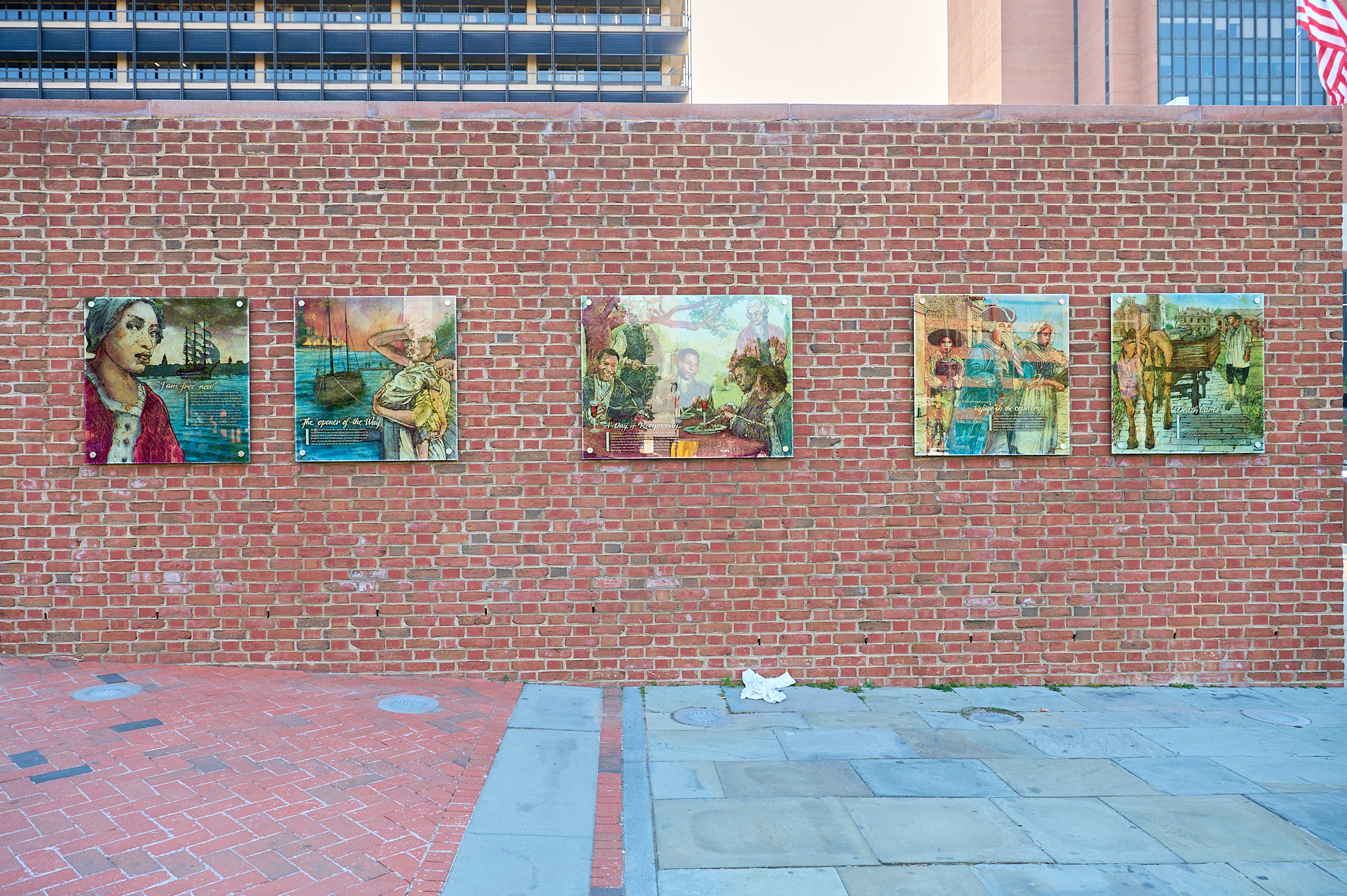
Photos showing some of Philadelphia’s early history lined a wall along the 2026 Freedom Walk. (Photo by Daniel Chen)