
Prior to 2025, every 10 years churches and other organizations in Pennsylvania had to file a decennial report with the PA Department of State to confirm that the business or non-profit organization is still active and using its registered name. Since 2025, Pennsylvania churches and others are now required to file an annual report with the Department of State, and the deadline for filing each year is June 30.
More information on the filing process is available by clicking here.
IMPORTANT INFORMATION
from Tim Hoy
Of Counsel, Mette Attorneys at Law
Consequences of Not Filing
The consequences are a three-step process.
First: the Corporation Bureau (which is part of Pennsylvania’s Dept. of State) will notify an entity that the Bureau intends to dissolve the entity, if the entity has failed to file an annual report within six months of the date when the report was due.
Second: if the entity fails to file the annual report within 60 days of the notice from the Bureau, the Bureau must file a statement of administrative dissolution AND deliver a copy of the statement to the entity. After the statement of dissolution is filed, THE ONLY ACTIVITY IN WHICH THE ENTITY IS ALLOWED TO ENGAGE IS WINDING UP THE AFFAIRS OF THE ENTITY.
Third: after an entity is administratively dissolved, it may apply for reinstatement. However, it will have lost the exclusive right to its name in the meantime. If another church files articles of incorporation while a church is in the state of administrative dissolution, the new church can use the name of the dissolved church. Not likely in the case of a church named “Second Presbyterian Church of __________,” but it is a consequence.
NOTE: these consequences apply to annual reports due on or after Jan. 4, 2027. If a church hasn’t had its records consolidated in the Bureau by then, and is consequently unable to file an annual report, it will not be administratively dissolved.
Churches Formed in an Orphan’s Court
- Orphan records are a major cleanup project that the Bureau is dealing with one by one, as they are encountered.
- They are the records that were gathered and transferred from the counties to the Corporation Bureau in the 1990s per Pennsylvania law.
- Because of the volume and resources at the time of the transfer, county records were dumped into the existing system. Sometimes (often) this resulted in duplicate records, because the entity had already filed something later with the Department. Second Presbyterian Church of Carlisle is an example:
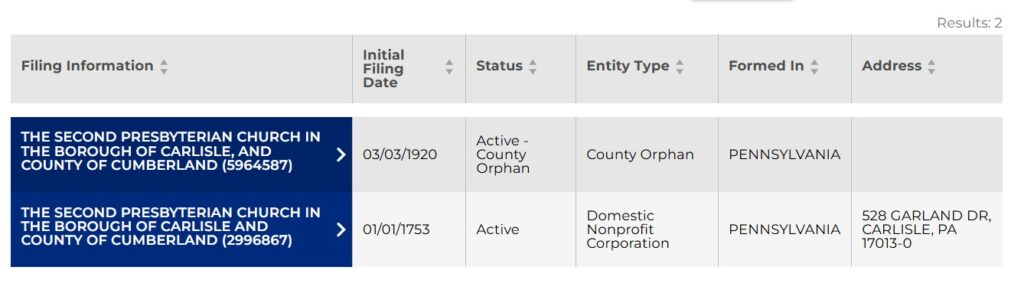
- When duplicate records are noticed or pointed out, the Bureau reviews each record and combines the county orphan into the existing domestic corporation record, updates the initial filing date (clearly it was not 1/1/1753 – that is a placeholder date the system puts in when there is no initial filing).
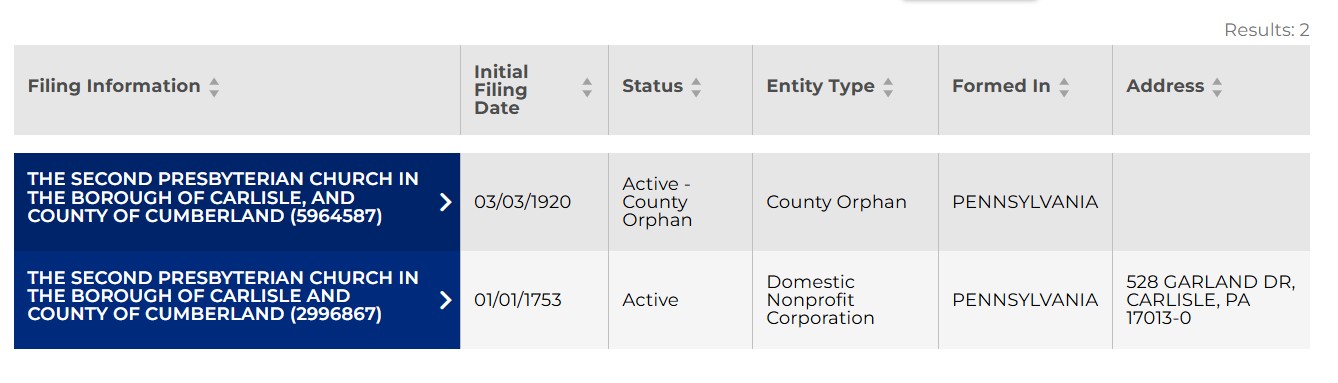
Some churches haven’t had their records combined yet. Once that happens, the church will be able to file its annual report. UNTIL THAT HAPPENS, there is no way for a church that was formed in an Orphan’s Court and which is not yet recognized in the Bureau as a nonprofit corporation to file an annual report.